Pharmaceutical CIP Skid System – Clean-in-Place System
Equilateral Solutions designs and manufactures hygienic Pharmaceutical CIP Skid Systems (Clean-in-Place Systems) for automated and controlled cleaning of pharmaceutical process equipment. Our CIP systems are engineered to clean product-contact surfaces of manufacturing vessels, storage tanks, mixing tanks, reactors, pipelines, pumps, and heat exchangers without requiring major equipment dismantling.
Designed around pharmaceutical GMP requirements and hygienic engineering principles, our CIP systems support repeatable cleaning operations, reduced manual intervention, and effective removal of product residues, processing chemicals, and cleaning agents from process equipment.
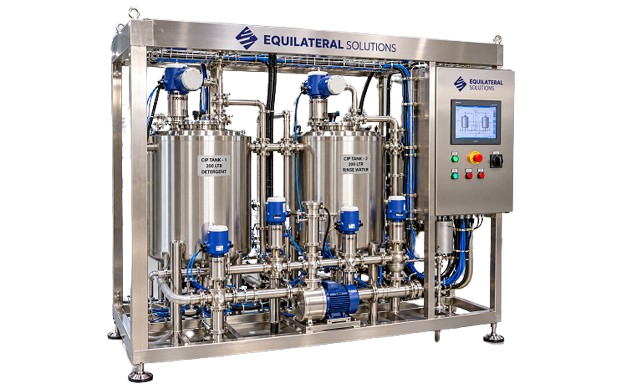
Available in Single-Tank, Two-Tank, and Three-Tank CIP configurations, our systems can be customized according to cleaning procedures, equipment configuration, plant layout, process requirements, and automation levels.
Manufactured using high-quality SS304 or SS316L stainless steel, our CIP skid systems can be equipped with hygienic pumps, sanitary valves, automated chemical dosing, heating arrangements, instrumentation, and PLC-HMI-based controls to support controlled pharmaceutical cleaning operations.
Types of Pharmaceutical CIP Skid Systems
1. Single-Tank CIP System
A compact and economical solution designed for basic pharmaceutical equipment cleaning applications.
The system uses a single tank for preparing and circulating cleaning solutions through process equipment. Different cleaning stages can be managed through controlled filling, heating, circulation, draining, and rinsing sequences.
Suitable for standalone pharmaceutical vessels, mixing tanks, storage tanks, and smaller production systems requiring controlled cleaning operations.
2. Two-Tank CIP System
Designed with two separate tanks to provide improved cleaning flexibility and management of cleaning solutions.
Depending on the cleaning procedure, the tanks can be configured for:
- – Hot water and chemical cleaning solution.
- – Rinse water and alkaline cleaning solution.
- – Separate preparation and storage of cleaning media.
The configuration supports efficient cleaning solution management and can help optimize cleaning cycle time in pharmaceutical manufacturing facilities.
3. Three-Tank CIP System
Designed for comprehensive pharmaceutical cleaning applications requiring multiple cleaning solutions and controlled cleaning stages.
The system typically incorporates three separate tanks for:
- – Hot or rinse water.
- – Alkaline cleaning solution.
- – Acid or other specified cleaning solution.
This arrangement allows different cleaning solutions to be prepared, stored, circulated, and managed separately.
Suitable for larger pharmaceutical manufacturing facilities with multiple process vessels, reactors, mixing systems, and interconnected product transfer pipelines.
Key Features of Pharmaceutical CIP Skid System
1. GMP-Oriented Stainless Steel Construction
Our pharmaceutical CIP skid systems are manufactured using SS304 or SS316L stainless steel, depending on product-contact and process requirements.
The design can incorporate hygienically finished internal surfaces, sanitary connections, drainable piping, suitable gasket materials, and minimized dead-leg arrangements to support effective cleaning.
Internal surface finish requirements can be customized according to project specifications and applicable pharmaceutical GMP requirements.
2. Automated CIP Operation
The systems can be equipped with PLC-HMI-based automation to control and monitor different cleaning stages.
Automated operation can include:
- – Pre-rinse and water circulation.
- – Cleaning chemical preparation.
- – Controlled chemical circulation.
- – Intermediate and final rinsing.
- – Temperature monitoring and control.
- – Cleaning solution recovery and return.
- – Automated cleaning sequence management.
Recipe-based cleaning programs can be configured according to different equipment and cleaning procedures.
3. Efficient Cleaning Solution Circulation
Hygienic centrifugal pumps are selected according to required flow rates, pressure, and process equipment configuration.
The circulation system is designed to deliver appropriate cleaning solution flow through vessels, pipelines, heat exchangers, and other product-contact surfaces.
Flow monitoring and return-line arrangements can be incorporated to support consistent cleaning operations.
4. Controlled Heating System
Optional steam-based or electrical heating arrangements can be provided to maintain the required cleaning solution temperature.
RTD temperature sensors, temperature transmitters, and automated control valves can be integrated for monitoring and controlling cleaning temperatures throughout the cleaning cycle.
5. Chemical Dosing & Conductivity Monitoring
Automated chemical dosing arrangements can be incorporated for controlled preparation and replenishment of cleaning solutions.
Optional conductivity monitoring helps assess cleaning solution concentration and supports controlled management of cleaning chemicals.
The chemical dosing system can be customized according to the selected cleaning agents and process requirements.
6. Hygienic Piping & Sanitary Valve Arrangement
The CIP skid can incorporate SS316L product-contact piping, sanitary fittings, hygienic valves, suitable gaskets, and dedicated cleaning supply and return connections.
The piping arrangement is designed to minimize product retention, facilitate drainage, and support effective cleaning of connected process equipment.
7. Instrumentation & Process Monitoring
Depending on project requirements, the system can be equipped with instrumentation for monitoring critical cleaning parameters, including:
- – Temperature sensors and transmitters.
- – Flow meters and flow switches.
- – Pressure gauges and pressure transmitters.
- – Tank level sensors.
- – Conductivity meters.
- – Chemical dosing monitoring.
- – Automated valve position monitoring.
These instruments can be integrated with the PLC-HMI system for process monitoring, alarms, and cleaning cycle management.
8. PLC-HMI Automation & Data Monitoring
Optional PLC-HMI automation enables controlled operation of cleaning sequences and monitoring of process parameters.
Depending on the required automation level, features can include:
- – Recipe-based cleaning programs.
- – Automated valve sequencing.
- – Temperature and flow monitoring.
- – Cleaning cycle timers.
- – Alarm and fault monitoring.
- – Batch-wise cleaning records.
- – User access management.
- – Data logging and report generation.
Additional electronic record and audit trail functionality can be specified where required by the pharmaceutical facility’s regulatory and data integrity requirements.
Typical Pharmaceutical CIP Cleaning Cycle
The CIP cleaning procedure is developed according to the manufacturing process, nature of product residues, equipment design, cleaning agents, and approved cleaning protocols.
A typical pharmaceutical CIP sequence may include:
1. Pre-Rinse
Initial water circulation to remove loose product residues and prepare the equipment for chemical cleaning.
2. Alkaline Cleaning
Circulation of an appropriate alkaline cleaning solution to remove organic residues, including product deposits, oils, and other process contaminants.
3. Intermediate Rinse
Water circulation to remove residual alkaline cleaning solution from product-contact surfaces.
4. Acid Cleaning
Where required, circulation of a suitable acid cleaning solution to remove mineral deposits and inorganic residues.
5. Final Rinse
Final rinsing using specified water quality, such as purified water, to remove residual cleaning agents.
6. Final Sanitization or Thermal Treatment
Where required, an approved sanitization or thermal treatment stage can be incorporated according to the equipment, product, and cleaning validation requirements.
Note: Cleaning sequences, chemical concentrations, temperatures, circulation times, water quality, and acceptance criteria must be established and validated according to the pharmaceutical product, equipment, and approved cleaning procedures.
Applications of Pharmaceutical CIP Skid Systems
Our stainless steel CIP skid systems are suitable for cleaning a wide range of pharmaceutical manufacturing equipment and process systems, including:
- – Pharmaceutical Manufacturing Vessels: Cleaning of manufacturing vessels, formulation tanks, and process containers.
- – Reactors & Mixing Tanks: Cleaning of stainless steel reactors, blending vessels, and mixing equipment used in pharmaceutical production.
- – Storage Tanks: Cleaning of purified water storage tanks, liquid formulation tanks, and intermediate product storage vessels.
- – Liquid Pharmaceutical Manufacturing: Cleaning of equipment used for syrups, oral liquids, suspensions, and other liquid formulations.
- – API Manufacturing: Cleaning of compatible process vessels, pipelines, and product-contact equipment used in active pharmaceutical ingredient manufacturing.
- – Ointment & Cream Manufacturing: Cleaning of suitable manufacturing vessels, mixing systems, and associated pipelines.
- – Biopharmaceutical Processing: Cleaning of compatible process equipment and product-contact systems used in biopharmaceutical manufacturing.
- – Purified Water & WFI Systems: Cleaning and sanitization of compatible water storage and distribution equipment, subject to specific system design requirements.
- – Process Pipelines & Heat Exchangers: Cleaning of interconnected product transfer lines, pumps, and heat exchange equipment.
Technical Specifications of Pharmaceutical CIP Skid System
| Parameter | Specification |
|---|---|
| Equipment Type | Pharmaceutical CIP Skid System |
| Material of Construction | SS304 / SS316L |
| Design | GMP-Oriented Hygienic Design |
| System Configuration | Single-Tank / Two-Tank / Three-Tank |
| Tank Capacity | Customized as per Requirement |
| Cleaning Method | Automated / Semi-Automated |
| Circulation Pump | Hygienic Centrifugal Pump |
| Heating System | Steam / Electrical Heating |
| Chemical Dosing | Manual / Automatic |
| Cleaning Media | Purified Water / Alkaline / Acid / Other Specified Solutions |
| Piping Material | SS304 / SS316L |
| Valve Arrangement | Manual / Pneumatic Sanitary Valves |
| Instrumentation | Temperature / Flow / Pressure / Level / Conductivity |
| Control System | Local Panel / PLC-HMI |
| Automation | Recipe-Based / Customized |
| Data Monitoring | Optional Data Logging / Batch Records |
| Connections | TC / Customized Sanitary Connections |
| Design & Capacity | Fully Customizable |
Note: Final material grades, surface finish, tank capacity, pump specifications, instrumentation, automation, and piping configuration are finalized according to the customer URS, equipment requirements, and applicable pharmaceutical GMP requirements.
Customized Pharmaceutical CIP Skid Systems
Equilateral Solutions provides customized Pharmaceutical Clean-in-Place (CIP) Systems engineered according to the client’s User Requirement Specification (URS), process equipment configuration, cleaning philosophy, and available utilities.
Our systems can be configured with single-tank, two-tank, or three-tank arrangements, depending on the number of equipment units, cleaning cycles, cleaning media, and plant production requirements.
Available customization options include:
- – SS316L product-contact construction.
- – Customized tank capacities and configurations.
- – Steam or electrical heating arrangements.
- – Automated chemical dosing systems.
- – Conductivity-based chemical concentration monitoring.
- – Temperature, flow, pressure, and level instrumentation.
- – Automated pneumatic sanitary valves.
- – Recipe-based cleaning programs.
- – Automatic CIP supply and return control.
- – PLC-HMI-based process automation.
- – Batch-wise cleaning records and data logging.
- – Customized piping, pumps, and instrumentation.
- – Optional audit trail and electronic record functionality as per project requirements.
Advantages of Pharmaceutical CIP Skid System
- – Improved Cleaning Consistency: Automated cleaning sequences help achieve repeatable cleaning conditions.
- – Reduced Manual Intervention: Enables cleaning of compatible process equipment without major dismantling.
- – GMP-Oriented Construction: Hygienic stainless steel design supports pharmaceutical manufacturing requirements.
- – Controlled Cleaning Parameters: Monitoring of temperature, flow, pressure, and chemical concentration supports controlled cleaning operations.
- – Reduced Cross-Contamination Risks: Properly designed and validated cleaning procedures help minimize product carryover.
- – Efficient Cleaning Operations: Automated cleaning sequences help optimize equipment cleaning and turnaround time.
- – Improved Documentation: Optional data logging and batch records support cleaning documentation requirements.
- – Customized Integration: Can be integrated with existing pharmaceutical vessels, reactors, tanks, and process pipelines.
Why Choose Equilateral Solutions for Pharmaceutical CIP Systems?
Equilateral Solutions specializes in designing and manufacturing stainless steel process equipment and hygienic engineering solutions for pharmaceutical and allied industries.
Our pharmaceutical CIP skid systems are developed with a focus on GMP-oriented construction, reliable cleaning circulation, process automation, and application-specific customization.
From compact single-tank CIP systems to automated multi-tank cleaning installations, we provide solutions designed around your process equipment, cleaning requirements, plant layout, and operational needs.
Get a Quote for Pharmaceutical CIP Skid System
Looking for a customized Pharmaceutical CIP Skid System for your manufacturing facility? Contact Equilateral Solutions to discuss your requirements for pharmaceutical CIP systems, automated cleaning equipment, and hygienic stainless steel process solutions.